What Is Seamless Activewear? Everything You Need to Know
In recent years, seamless activewear has become one of the most frequently requested product categories among fitness, athleisure, and lifestyle brands.
During sampling and quotation stages, brands often ask:
- "Is seamless activewear really better?"
- "Why does seamless cost more than cut-and-sew?"
- "Is seamless the right choice for my brand?"
This article answers all of those questions clearly and objectively. It is also the exact framework Bloomto Sportswear uses when guiding brands through seamless vs seamed development decisions.
What Are Seamless Activewears? An Introduction
Seamless activewear refers to garments primarily produced using circular knitting machines, where the body of the garment is knitted as a continuous tube rather than cut into multiple fabric panels and sewn together.
Unlike traditional cut-and-sew activewear, seamless garments are knitted directly into shape, have minimal or no side seams, and can integrate stretch, compression, ventilation, and texture directly into the fabric structure.
Where it��s commonly used
- Fitness & gym wear
- Yoga & Pilates apparel
- Athleisure and lifestyle collections
- Performance base layers
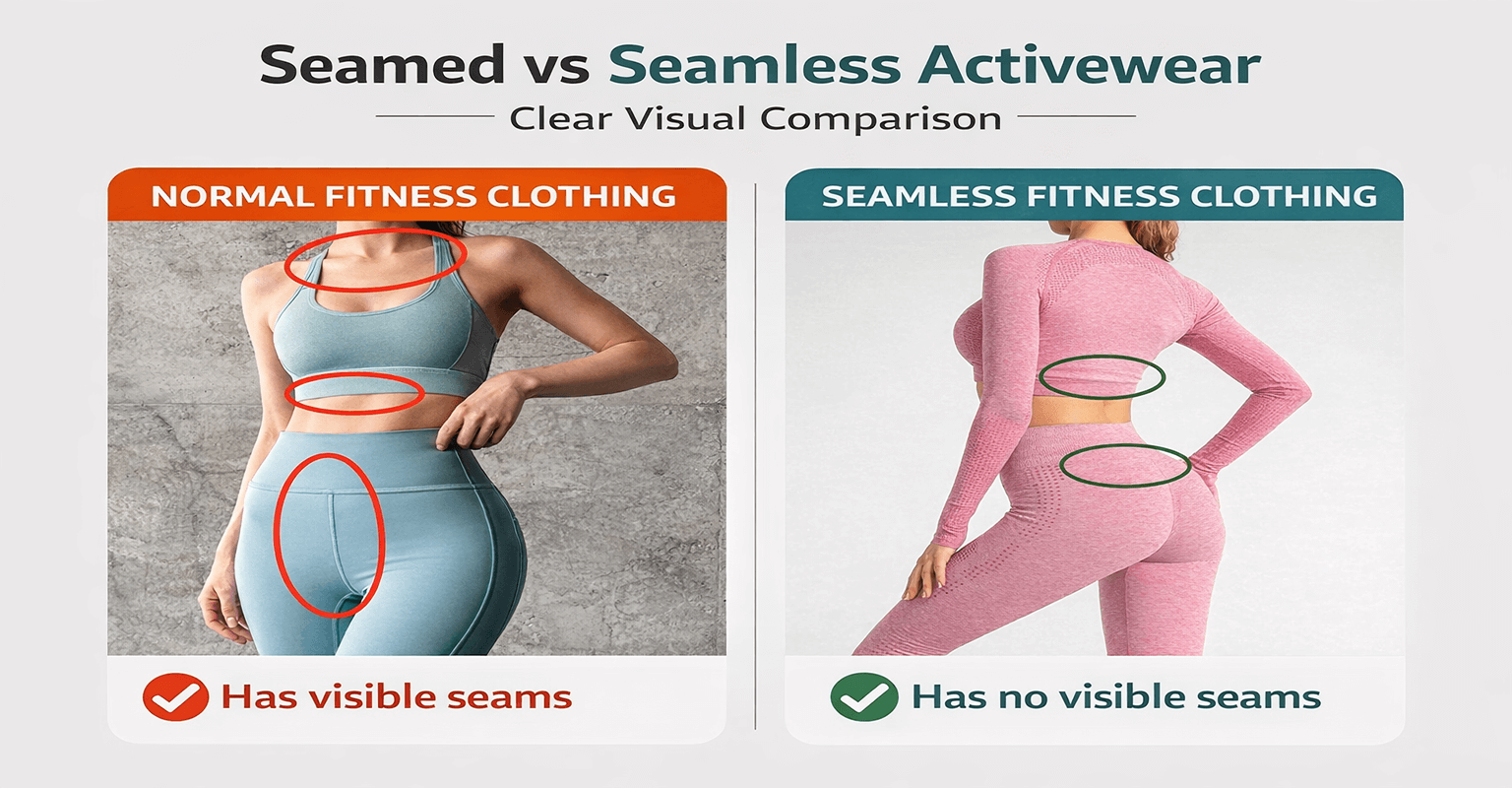
Is Seamless Clothing Completely Seamless or Stitch-Free?
This is one of the most common misunderstandings.
? Seamless does NOT mean zero stitching.
In reality, the main body of the garment is knitted seamlessly, but certain areas still require stitching for durability and structure, such as:
- Waistbands
- Shoulder connections
- Crotch reinforcement
- Armholes or neckline finishes
So what does ��seamless�� actually mean?
| Area | Seamless Garment | Traditional Seamed Garment |
|---|---|---|
| Body construction | One-piece knitted tube | Multiple cut panels |
| Side seams | None or minimal | Always present |
| Stitching role | Reinforcement only | Structural shaping |
| Skin comfort | Very high | Depends on seam quality |
At Bloomto, we always clarify this before sampling so your product claims stay accurate and customer expectations match real performance.
Why Was Seamless Gym Clothing Born?
Seamless activewear didn't emerge as a trend �� it emerged as a solution.
Original problems with traditional cut-and-sew
- Chafing during repetitive movement
- Pressure points at seams
- Limited stretch at seam junctions
- Visible seam lines affecting aesthetics
What seamless technology improved
- Reduced friction against skin
- Better stretch recovery
- More even compression
- Cleaner, modern silhouette
Seamless started in performance sports, then quickly expanded into athleisure because it matches what modern customers want: comfort, clean design, and versatile wearability.
What Are the Benefits of Seamless Activewears?
1) Enhanced comfort
Minimal seams mean less irritation and a smoother feel for yoga, gym training, and long-day wear.
2) Built-in stretch & compression
Compression zones can be knitted into the garment, creating more consistent support without relying on seam tension.
3) Cleaner aesthetic
A smooth silhouette aligns with minimalist and premium brand positioning.
4) Body-adaptive fit
Knit structure adapts to movement and can be more forgiving across sizes when engineered correctly.
5) Strong brand differentiation
Seamless is often perceived as "higher-end," helping justify premium pricing when performance is validated.
Bloomto��s Seamless Activewear Options
At Bloomto Sportswear, we don't recommend seamless blindly. We offer seamless solutions where they make sense �� based on product type, target margin, and your brand positioning.
| Seamless Product Type | Common Applications |
|---|---|
| Seamless gym leggings | Training, yoga, athleisure |
| Seamless gym shorts | Gym, cycling, lifestyle |
| Seamless sports bras | Light to medium support |
| Seamless tank tops | Gym & casual layering |
| Seamless long-sleeve tops | Base layers, yoga |
| Seamless bodysuits | Fashion-active crossover |
| Seamless ribbed sets | Lifestyle & lounge |
What we customize at Bloomto
- Yarn composition (nylon / polyester / elastane)
- Compression mapping & ventilation zones
- Rib, jacquard & mesh textures
- Logo knitting or heat transfer
- Color development & lab dips
- Size grading for brand-specific fits
Note: Low MOQ can start from ~100 pcs per color/style depending on yarn and machine setup.
The Development Prospect of the Seamless Clothing Industry
The seamless activewear category continues to grow �� but more selectively than before. Brands today are choosing seamless for the right products, not for everything.
Key trends we see
- From "fully seamless"to hybrid seamless (strategic seams where needed)
- From heavy compression to comfort-driven performance
- From gym-only to gym-to-street versatility
What��s next
- Seamless bodies + strategic seams for better fit control
- Sustainability-driven yarn innovation
- Smarter machine programming for cost optimization
Seamless vs Seamed Activewear: A Clear Comparison
Here's the most practical comparison table you can share with your team (or even paste into a supplier discussion):
| Aspect | Seamless Activewear | Seamed (Cut-and-Sew) Activewear |
|---|---|---|
| Production method | Circular knitting | Cut & sew panels |
| Cost | Higher | Lower |
| Fit consistency | Medium (depends on programming) | High (pattern controlled) |
| Design flexibility | Limited by machine capabilities | Very high |
| Sampling speed | Slower | Faster |
| Best for | Core basics, matching sets | Complex styles, fashion details |
| MOQ flexibility | Lower flexibility | More flexible |
Seamless is not "better�� �� it is "different."The right choice depends on your customer, your price point, and your product strategy.
How Bloomto Helps Brands Make the Right Choice
At Bloomto, our role is not to sell trends. Our role is to help brands avoid costly mistakes �� by making development decisions based on data, fit, and long-term viability.
Bloomto Seamless Decision Framework
- Brand positioning analysis (performance vs lifestyle vs premium basics)
- Target price & margin evaluation (what cost level makes sense)
- Product lifecycle planning (core evergreen vs seasonal trend)
- Fabric & opacity testing (squat-proof, stretch recovery)
- Fit validation across sizes (grading and tolerance control)
- Cost vs value assessment (where seamless adds true value)
We usually recommend seamless for:
- Core leggings (minimal silhouette)
- Matching sets (leggings + bra + top)
- Ribbed lifestyle collections
We usually avoid seamless for:
- Highly complex fashion designs
- Low price-point programs
- Short lifecycle trend items
We keep the risk inside the factory �� and deliver certainty to brands.
Final Thoughts
Seamless activewear is a powerful tool �� when used correctly. The real question is not ��Should we do seamless?�� but:
"Does seamless serve our brand, our customer, and our long-term product strategy?"
If you're evaluating seamless activewear for your next collection, Bloomto Sportswear can support you from yarn selection and knit programming to testing, fit validation, and bulk production control.