Sports Bra Support Engineering : How Brands Build Real Support (Not Just "Tightness")
When customers say a sports bra is "supportive,"they usually mean breast movement feels controlled, weight feels distributed, and comfort stays stable over time—even during running, jumping, and repeated arm swings. Research-backed guidance often frames support as the bra's ability to limit breast movement via design and fit choices.
As a custom sports bra manufacturer, Bloomto approaches "support"as an engineering system—structure + materials + pattern + construction + testing—so brands can build light / medium / high-support collections with consistent fit and performance.
As a custom sports bra manufacturer, Bloomto approaches "support"as an engineering system—structure + materials + pattern + construction + testing—so brands can build light / medium / high-support collections with consistent fit and performance.
What "Support"Actually Means in Engineering Terms
Support is not one feature. It's the combined outcome of:
1. Breast motion control strategy
• Compression: presses tissue closer to chest wall
• Encapsulation: supports each breast with cup structure
• Hybrid: combines both for high-impact stability
2. Load path design (where forces go)
A good support bra routes forces from breast mass into:
• Underband (primary anchor)
• Frame/wing/back panel (stability)
• Straps (fine-tuning, not the main load-bearing part)
3. Comfort & wearability constraints
If the bra restricts breathing, rubs skin, or overheats, users perceive it as "not supportive,"even if bounce is reduced.
1. Breast motion control strategy
• Compression: presses tissue closer to chest wall
• Encapsulation: supports each breast with cup structure
• Hybrid: combines both for high-impact stability
2. Load path design (where forces go)
A good support bra routes forces from breast mass into:
• Underband (primary anchor)
• Frame/wing/back panel (stability)
• Straps (fine-tuning, not the main load-bearing part)
3. Comfort & wearability constraints
If the bra restricts breathing, rubs skin, or overheats, users perceive it as "not supportive,"even if bounce is reduced.
The 5-Core Components of Support Structure
(1) Underband: the real "foundation"
Sports Medicine AustraliaSports Medicine…
Engineering checklist
• Band height (wider = more anchoring surface)
• Elastic modulus & recovery (won't relax after washing)
• Inner stability (grip/clean finish to reduce roll)
Bloomto's sports-bra development flow starts with band stability first, then builds cup + back structures around it, to avoid "strap-dependent"support.
(2) Cup system: compression vs encapsulation (and why brands need both)
Encapsulation structures typically use more defined cup architecture to separate and suspend, while compression reduces motion by holding tissue as a unit. Hybrid designs combine both for demanding movement.
Quick decision guide
| Your customer use case | Recommended support strategy | Typical structure features |
| Yoga / Pilates / daily athleisure | Light–Medium | soft compression + flexible cup/pad |
| Gym training / HIIT | Medium–High | hybrid: compression + reinforced frame |
| Running / jumping sports | High | hybrid + stronger band + stabilized back |
(Design still depends on cup size range + fabric behavior.)
(3) Strap geometry: distribute force, don't "hang"support
What to engineer
• Strap width & elasticity (too stretchy = bounce)
• Adjustability (important for fit lifespan)
Sports Medicine AustraliaSports Medicine…
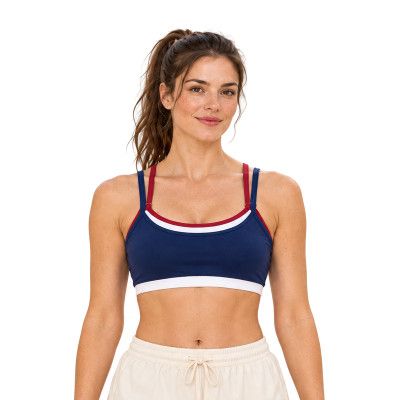
• Placement: racerback / cross-back / U-back to control lateral movement
Bloomto's custom options explicitly include cross-back/racerback/U-back configurations to match different motion scenarios (yoga, gym, running).
(4) Back/wing panels: stability is "anti-twist"
A supportive bra resists:
• vertical bounce
• side-to-side sway
• twisting during arm swing
Engineering moves
• Power mesh wings
• Stabilizer tape along top wing edge
• Wider back for load distribution (especially for larger cup ranges)
(5) Stitching & seam strategy: reduce irritation, preserve shape
Even strong designs fail if seams chafe or pop.
Common solutions
• Flatlock to reduce rubbing
• Clean finishing at armhole & neckline
• Seam placement away from high-friction zones
High-support design guidance often highlights avoiding abrasive seams and focusing on smooth contact surfaces.
Materials Engineering: "Support" Comes From Fabric Behavior
Support is heavily controlled by 3 measurable fabric behaviors:
1. Modulus (power): how strongly fabric resists stretch
2. Recovery: how well it returns after repeated extension
3. Breathability / moisture management: keeps comfort stable under sweat
Brand pitfall: Choosing soft yoga handfeel fabric for high-impact running bras can create “initial comfort” but poor long-term support.
Bloomto highlights fabric + craftsmanship dual control and sports-bra-specific manufacturing focus for stable performance across production runs.
1. Modulus (power): how strongly fabric resists stretch
2. Recovery: how well it returns after repeated extension
3. Breathability / moisture management: keeps comfort stable under sweat
Brand pitfall: Choosing soft yoga handfeel fabric for high-impact running bras can create “initial comfort” but poor long-term support.
Bloomto highlights fabric + craftsmanship dual control and sports-bra-specific manufacturing focus for stable performance across production runs.
Support Level Engineering: Light / Medium / High (How to Spec It for OEM/ODM)
Instead of only naming "support level,"define the spec package:
Light Support Spec Package
• Softer compression
• Minimal frame
• Lighter elastic
• Comfort-first silhouette (studio + lifestyle)
Medium Support Spec Package
• Hybrid tendencies (controlled compression + shape)
• Stabilized band and wing
• Better bounce control for gym + mixed training
High Support Spec Package
• Hybrid mandatory (compression + encapsulation)
• Stronger band + stabilized cup/frame
• More rigid control zones (mesh, stabilizers)
Light Support Spec Package
• Softer compression
• Minimal frame
• Lighter elastic
• Comfort-first silhouette (studio + lifestyle)
Medium Support Spec Package
• Hybrid tendencies (controlled compression + shape)
• Stabilized band and wing
• Better bounce control for gym + mixed training
High Support Spec Package
• Hybrid mandatory (compression + encapsulation)
• Stronger band + stabilized cup/frame
• More rigid control zones (mesh, stabilizers)
• Hardware designed for durability (adjusters, closures)
What to tell your manufacturer: "High support"is not a label—it's a BOM + pattern + construction standard.
Fit Engineering: Support Fails When Fit Fails
A sports bra feels supportive when the band anchors, the cups contain, and the straps stabilize—without pain. Even the best structure won't work if:
• band is too loose or rides up
• cup tissue spills or gaps
• straps slip or dig in
• band is too loose or rides up
• cup tissue spills or gaps
• straps slip or dig in
Bloomto's Practical OEM/ODM Workflow for Support-Engineered Sports Bras
Bloomto positions its sports bra program around data-driven fit optimization, multi-scenario structures, and flexible production for brands.
A practical development flow many established brands follow with manufacturers like Bloomto:
1. Define target scenario (Yoga / Gym / Running / Lifestyle)
2. Select support strategy (Compression / Encapsulation / Hybrid)
3. Lock the foundation (band + wing stability)
4. Build cup architecture (shape + containment + bounce control)
5. Prototype & wear-test (motion + comfort + heat)
6. Stability check after wash (recovery + hardware durability)
If you're building a full sports bra line, Bloomto also showcases multiple popular bra types (racerback, high neck, front clasp, etc.) that can be engineered into different support levels.
A practical development flow many established brands follow with manufacturers like Bloomto:
1. Define target scenario (Yoga / Gym / Running / Lifestyle)
2. Select support strategy (Compression / Encapsulation / Hybrid)
3. Lock the foundation (band + wing stability)
4. Build cup architecture (shape + containment + bounce control)
5. Prototype & wear-test (motion + comfort + heat)
6. Stability check after wash (recovery + hardware durability)
If you're building a full sports bra line, Bloomto also showcases multiple popular bra types (racerback, high neck, front clasp, etc.) that can be engineered into different support levels.
FAQ
Q1. What is sports bra "support engineering"?
Sports bra support engineering means designing support as a system—band anchoring, cup structure, strap geometry, back stability, and materials—so bounce control stays consistent in real movement. At Bloomto, we translate your target activity (yoga, training, running) into a clear structure spec and sampling plan.
q2. What makes a sports bra truly supportive?
A sports bra feels supportive when the underband anchors, the cups contain, and the back/straps stabilize—without digging or slipping. Bloomto focuses on band stability first, then optimizes cup and back structure to reduce "strap-dependent"discomfort.
q3. Compression vs encapsulation: which gives better support?
Compression reduces movement by holding tissue closer to the body—great for low to medium impact.
• Encapsulation supports each breast with cup structure—often better for shape and larger busts.
• Hybrid combines both and is commonly the best choice for high impact.
Bloomto can prototype all three so your brand can test and choose the best support strategy.
• Encapsulation supports each breast with cup structure—often better for shape and larger busts.
• Hybrid combines both and is commonly the best choice for high impact.
Bloomto can prototype all three so your brand can test and choose the best support strategy.
Q4. How do you design a high-impact sports bra for running?
High-impact designs typically use hybrid support, a firm underband, stabilized wings/back, and controlled strap stretch to reduce bounce. Bloomto helps brands build a running-ready structure package through OEM/ODM sampling, motion feedback, and fit refinement.
Q5.Does "tighter"always mean more support?
No. Over-tight bras can restrict breathing and still fail if the band rides up or cups don’t contain correctly. Bloomto targets support with comfort—stable anchoring, controlled stretch, and clean finishing—so the bra supports without pain.