
How to Design Custom Leggings: Tech Pack, Artwork & Sampling Guide
To design custom leggings, define how they should fit and perform, translate that brief into a tech pack, prepare artwork at its intended print size, and validate the finished design through samples before approving bulk production.
A polished mockup is a useful starting point. It does not tell a pattern maker how high the waistband should sit, tell a printer where a motif should meet a seam, or tell a quality inspector which measurements are acceptable. Those decisions need their own instructions.
At Bloomto, we help brands connect creative direction with product development. This guide explains what to prepare, what to ask your manufacturing partner, and how to turn sample feedback into a clear production reference.
What should you prepare first?
Start with a product brief, front and back sketches, your intended size range, fabric preferences and any logo or print files. If you do not yet have a complete tech pack, identify the missing decisions instead of filling them with guesses. A manufacturer can then review the development work your project actually needs.
1. Define fit and function before designing the details
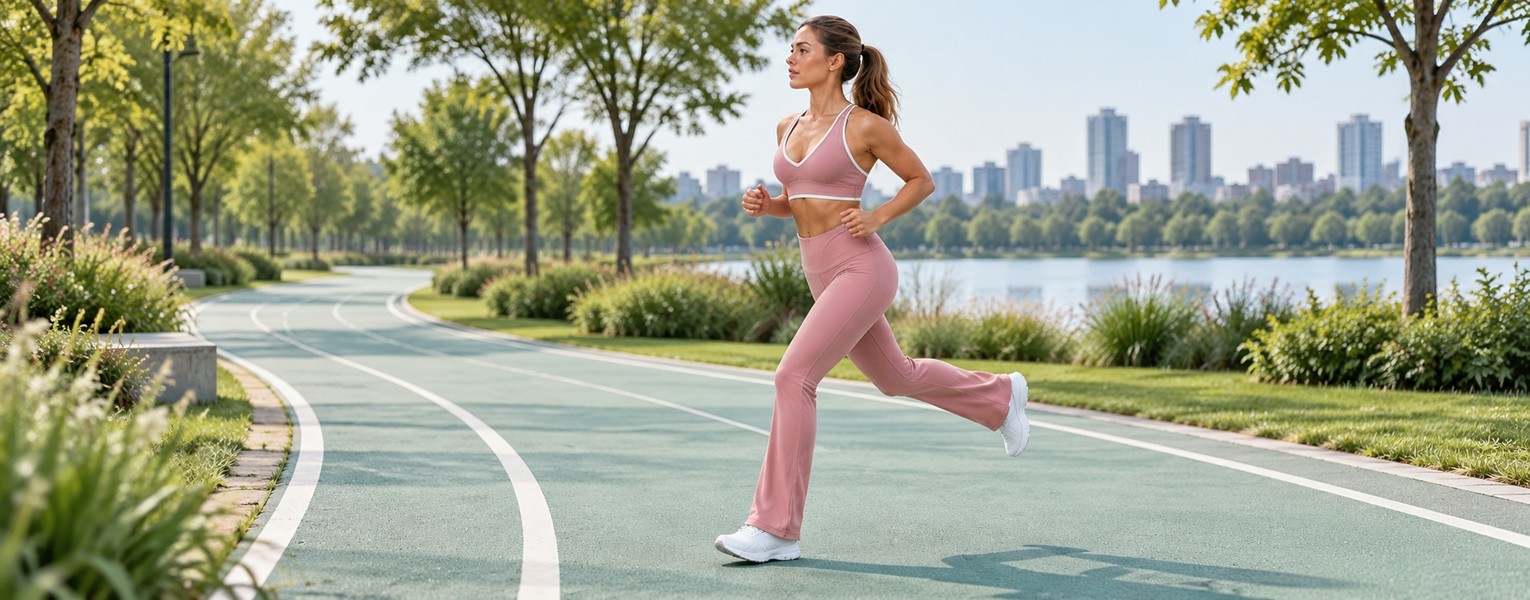
Decide who will wear the leggings and for which activity. A yoga style, a running tight and an everyday flare can share a brand identity without sharing the same construction. Describe the experience you want: freedom through deep bends, secure storage while moving, or an easy silhouette for everyday wear.
Then make that brief specific. Record the intended rise, waistband construction, leg shape, inseam, pocket requirements and seam placement. Include your target market, planned quantities, budget range and launch window so the team can assess feasibility alongside appearance.
Separate visual references from technical requirements. A photograph may communicate a curved seam or a color direction, but it cannot confirm fabric weight, stretch recovery or internal construction. Annotate what you like and what must change. Use original or appropriately licensed artwork, and develop your own product identity.
For silhouette references, explore our yoga leggings collection. Select a starting direction, then confirm the details that matter for your customers.
2. Build a tech pack the factory can work from
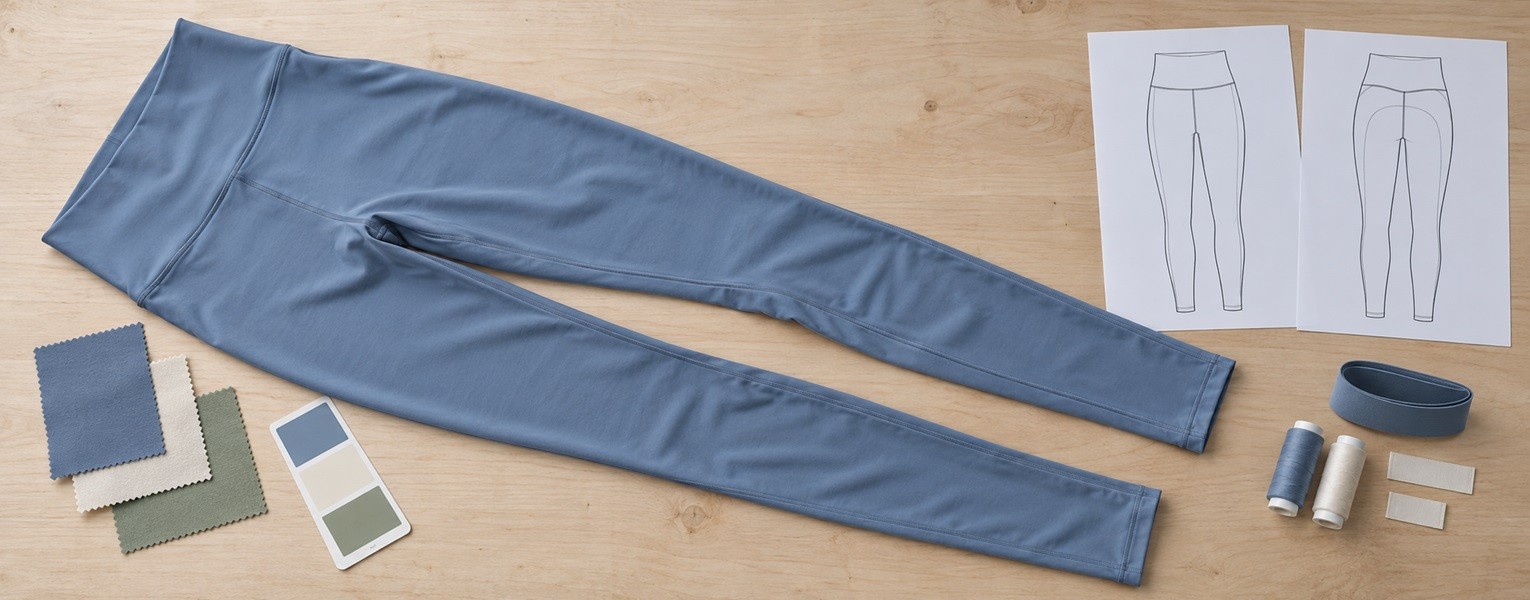
A tech pack is the shared specification for your garment. It should connect sketches, measurements, materials, artwork and approvals under one style number and revision date. It is not the same as a sewing pattern: the pattern defines the pieces used to construct the garment.
| Tech pack section | What to include | Why it matters |
|---|---|---|
| Style identity and drawings | Style code, revision date, front/back flats and enlarged detail views. | Keeps the team working on the same garment and version. |
| Bill of materials | Fabric reference, composition, weight in g/m², color, thread, elastic and trims. | Identifies what each part should be made from. |
| Measurements and grading | Base size, measurement diagrams, units, tolerances and size-to-size changes. | Makes fit requirements measurable across the size range. |
| Construction | Waistband, gusset, seams, hems, pocket openings and reinforcement details. | Explains features that a flat drawing alone cannot show. |
| Artwork and branding | File names, actual dimensions, placement references, colors and decoration method. | Connects the approved graphic to its position on the garment. |
| Labels, packing and approvals | Label content and placement, packaging, sample IDs, test requirements and revision log. | Records the remaining decisions before production release. |
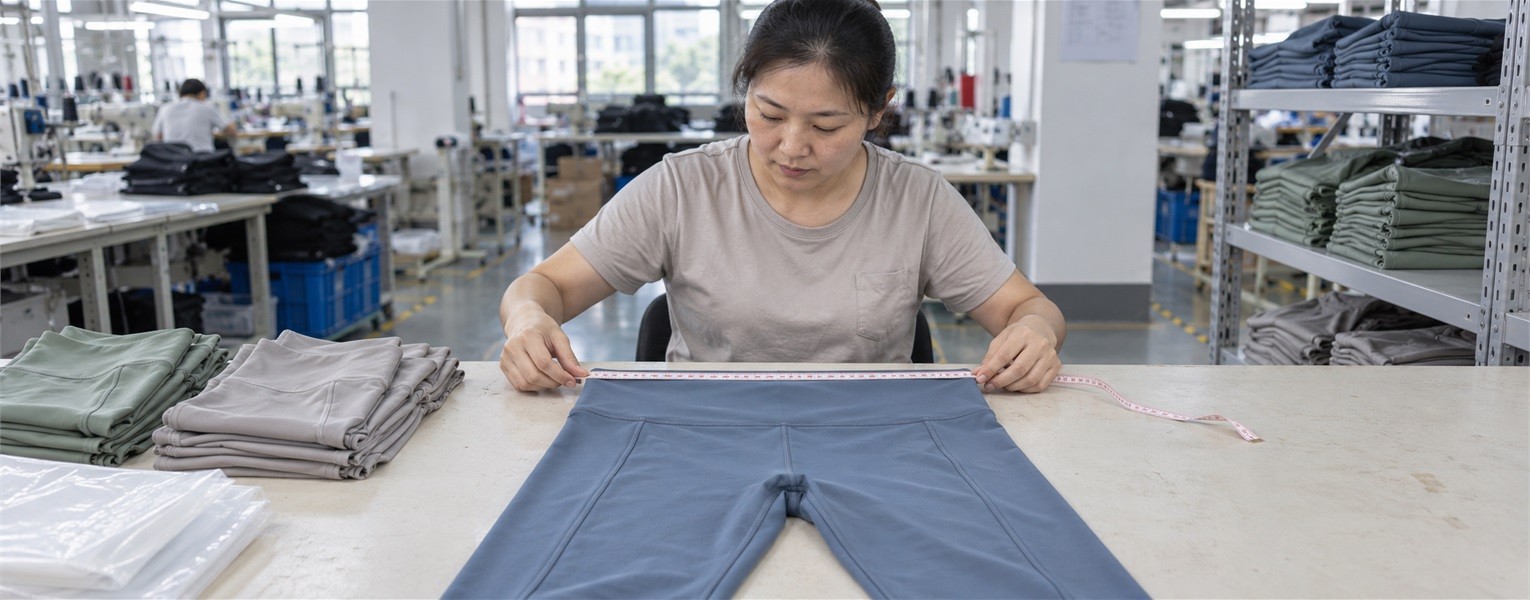
Define how every measurement is taken. “Waist: 34 cm” is incomplete. Does it mean the relaxed waistband measured flat, a stretched measurement, or a body measurement? Specify the garment position, measurement path and condition. Do the same for the hip, thigh, rise, inseam and leg opening.
Agree tolerances by measurement point and construction; do not copy a single allowance into every row. A base-size sample also does not establish the fit of the smallest and largest sizes. Review the grading approach and decide which additional sizes need physical validation.
If you only have sketches or reference images, our sportswear design and tech pack support can help develop drawings, measurement charts, patterns and material direction. Tell us what is already decided and where you need development input.
3. Prepare artwork at its real print size
Send editable source files as well as a viewable approval PDF. For vector logos, preserve editable shapes and resolve fonts or provide an outlined production copy. A PDF or AI extension alone does not guarantee vector artwork: an embedded low-resolution image remains raster content.
For all-over prints, confirm the pattern template, repeat dimensions, orientation and treatment at seams. For placed graphics, identify the anchor point and specify distances from garment features. Ask whether placement remains fixed or changes across sizes. Confirm bleed, safe areas, export format and color workflow with the production team before final export.
How many pixels does your artwork need?
Use the intended printed dimension, not the size of the mockup on your screen:
Pixels = printed size in cm ÷ 2.54 × PPI
| Printed width | At 150 PPI | At 300 PPI |
|---|---|---|
| 10 cm | 591 px | 1,182 px |
| 30 cm | 1,772 px | 3,544 px |
| 60 cm | 3,544 px | 7,087 px |
Bloomto calculations, rounded up to whole pixels. Apply the formula separately to width and height. PPI describes image pixels per inch; printer DPI is a different measure. The dimensional relationship is explained in Adobe’s resolution guidance.
The comparison shows why artwork requirements depend on its final size: doubling printed width at the same PPI requires twice as many pixels across. The two PPI values are examples, not universal textile-printing thresholds. Confirm the requirement for your selected process and approve a physical print sample.
Changing a resolution label without resampling does not create more pixels. Resampling interpolates pixel information; it is not a substitute for a detailed original. Adobe’s resizing instructions, updated February 2026, distinguish dimensions, resolution and resampling. Check the actual file, not just a “300 DPI” note in its name.
4. Confirm fabric, color and sizing together
Do not choose fabric from a composition label alone. Compare the actual swatches for hand feel, weight, stretch direction, recovery and appearance under extension. Treat opacity, moisture management and other performance claims as requirements to verify, not conclusions that follow automatically from a fiber blend.
Evaluate the fabric in the intended garment fit. A swatch resting on a desk does not represent the same extension as fabric across a hip or knee. If the material changes after a fit sample is approved, review which measurements, construction details and checks must be revisited.
For color, name the reference system and approve a physical result on the intended material. Pantone recommends a recent, unfaded physical standard when moving from digital design to a real product because screen color and physical color behave differently. Source: Pantone’s guidance on physical color samples.
Our practical recommendation is to record the approved swatch, lab dip or print strike-off by reference and date. A lab dip is a small dyed sample; a strike-off is a print trial on fabric. Agree viewing conditions and the acceptance approach with your supplier. A color code guides the target; it does not replace approval of the actual result.
Have artwork, but not a complete production brief?
Tell Bloomto which style, fabric and print direction you have in mind. We can review the development scope and help identify what needs to be confirmed before sampling.
Discuss My Leggings Design with Bloomto5. Review samples with a written decision trail
Give each sample a style code, size, version and date. Review it against the matching tech pack, then separate your comments into measurements, fit, material, construction and artwork. Annotated photos and a consolidated change list are more actionable than several disconnected messages saying “make it better.”
A useful comment identifies the location, observation and requested outcome: “The back waistband folds during a deep bend; review its height and construction, then recheck the next sample.” Do not prescribe a pattern change blindly when the cause has not been established.
Use separate approval stages
- Development sample: assess the silhouette, construction and initial fit. Record any substitute materials.
- Revised fit and size checks: confirm corrections, movement and the agreed grading approach.
- Material and artwork approvals: confirm fabric, color, print scale, placement, trims and labels.
- Pre-production approval: agree the sample and documents that will govern bulk production, including any explicitly recorded exceptions.
These are decision stages, not a promise of exactly four physical samples. Stages may overlap, and the number of sample rounds depends on the design and its revisions. An attractive prototype is not automatically ready for bulk release.
Make wash checks measurable and repeatable
ISO provides complementary methods: ISO 3759:2011 covers specimen preparation, marking and measurement; ISO 6330:2021 covers domestic washing and drying procedures; and ISO 5077:2007 addresses dimensional change after washing and drying.
ISO 6330 includes six drying procedures and notes that test parameters can affect results. Consequently, “washed and approved” needs context: record the selected procedure, number of cycles, measurement method and acceptance limits. Refer to the full applicable method for formal testing; this guide is not a test protocol.
A percentage needs a measurement behind it
If a marked length changes from 50.0 cm to 48.5 cm, the arithmetic is (48.5 − 50.0) ÷ 50.0 × 100 = −3.0%, meaning a 3.0% reduction.
This is a hypothetical calculation, not a Bloomto test result or an acceptable shrinkage limit. A pass/fail decision still requires the agreed test conditions and product specification.
6. Use a pre-production release checklist
Before authorizing bulk production, check that the following items agree with one another:
- Documents: final style code, tech pack revision, pattern and artwork versions.
- Fit: approved sample, size chart, measurement methods and tolerances.
- Materials: approved fabric, colors, elastic, thread and trims, with substitutions resolved.
- Branding: print dimensions and placement, logo version, labels and packaging.
- Quality: required tests, acceptance criteria, inspection scope and any open corrective actions.
- Order details: quantity by size and color, agreed commercial terms and delivery plan.
- Authorization: written approval identifying exactly what has been released.
Keep a retained approval reference accessible to both teams. If a change is requested later, identify which approvals it affects before accepting it. This helps distinguish a deliberate revision from an unintended production difference.
7. Avoid design mistakes that create extra work
Unclear priorities: listing every possible feature without identifying the essential ones makes trade-offs difficult. Separate must-have requirements from optional details.
Artwork that ignores the garment: a flat motif may cross a seam, pocket or high-stretch area. Review placement on the actual pattern and on the worn sample.
Late material changes: replacing fabric after approval can change the basis of the fit and appearance review. Treat it as a controlled revision.
Conflicting feedback: comments from several reviewers should be consolidated into one approved change list. Retire superseded files so production does not rely on an older attachment.
How Bloomto helps turn your design into a manufacturable product
You do not need to solve every technical question before contacting us. Bloomto supports concept development, tech packs, pattern and fit development, fabric and color selection, sampling and revisions. Our role is to connect your brand direction with the decisions needed to make the garment.
For your project, ask us to review the starting style, missing specifications and sample objectives together. Through our custom leggings manufacturing support, you can discuss fit options, fabrics, branding and the transition from approved samples to bulk production.
Include target quantities and timing in your inquiry. We will need the project details to confirm development scope, sampling arrangements, costs, minimum quantities and production timing. A guide cannot replace a style-specific quotation.
Frequently asked questions
What software do I need to design my own leggings?
You need tools that produce clear drawings, organized specifications and usable artwork. Vector and raster editors serve different purposes; a spreadsheet can organize measurements. Confirm accepted delivery formats with the factory. A polished application file does not replace a complete specification or physical sample.
Can I create custom leggings from an existing factory style?
Yes, an existing style can be a starting point. Identify what stays unchanged and what you want to adjust, such as fabric, waistband, length or branding. Ask Bloomto which options are feasible and which changes need new development or sampling.
What is the minimum print resolution for custom design leggings?
There is no single minimum established by this guide. Confirm the selected process, final print size and file requirements with the production team. Use the pixel calculation above for raster artwork, and approve a strike-off before relying on a screen preview.
Ready to develop your custom leggings?
Send Bloomto your design direction, target market, size range, expected quantity and launch window. If your tech pack is incomplete, tell us where you need help. We can discuss the next steps for design development, material selection and sampling.
Contact Bloomto About My Design
